
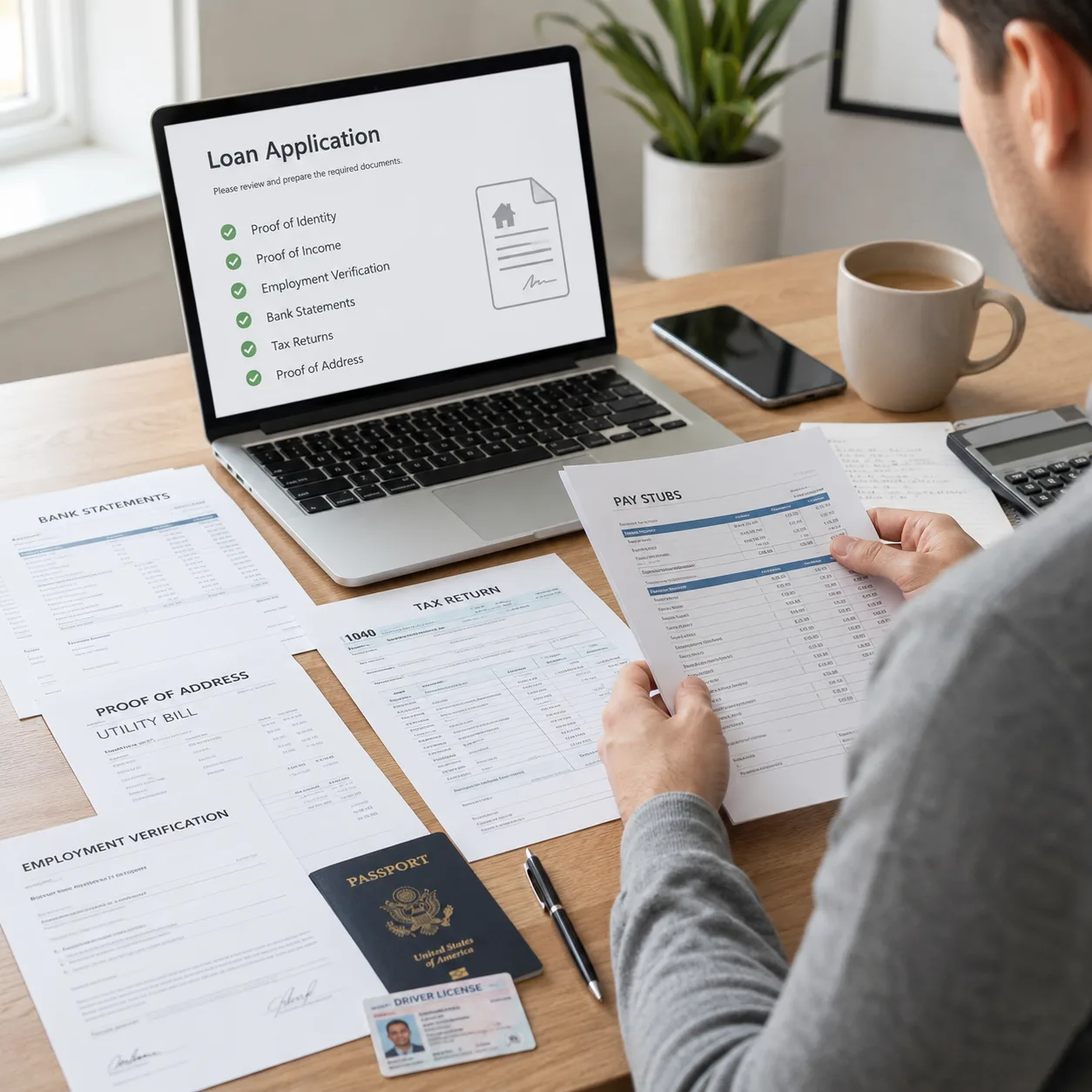
Knowing the loan application documents lenders require lets you apply faster and avoid the back-and-forth that delays funding. While exact requirements vary by lender and loan type, almost all want to confirm four things: who you are, where you live, what you earn, and where to send the money. This guide gives you the full checklist and explains the purpose of each item.
Quick answer: Most lenders ask for a government-issued photo ID, proof of income (recent pay stubs, tax returns, or bank statements), proof of address, your Social Security number, and bank account details for funding. Self-employed applicants typically add tax returns and business records.
The standard document checklist
- Government photo ID. Driver’s license, state ID, or passport to verify identity.
- Proof of income. Recent pay stubs, W-2s, or tax returns showing you can repay.
- Proof of address. A utility bill, lease, or bank statement with your name and address.
- Social Security number. Used for the credit check and identity verification.
- Bank account details. For depositing funds and setting up payments.
If you are self-employed
Without pay stubs, you will document income differently. Lenders usually want one to two years of tax returns, recent bank statements, and sometimes a profit-and-loss statement. The goal is the same: showing stable, sufficient income to repay the loan.
Why each document matters
| Document | What it proves |
|---|---|
| Photo ID | Your identity, to prevent fraud |
| Proof of income | Your ability to repay |
| Proof of address | Residency and contact verification |
| SSN | Credit history and identity check |
| Bank details | Funding and repayment setup |
Tips to speed up approval
- Gather digital copies (PDF or clear photos) before you start.
- Make sure names and addresses match across documents.
- Use recent files, pay stubs and statements from the last 30 to 60 days.
- Prequalify first so you only submit documents to the lender you choose.
Frequently asked questions
A government photo ID, proof of income (pay stubs, W-2s, or tax returns), proof of address, your Social Security number, and bank account details. Self-employed applicants usually add tax returns and bank statements.
Salaried applicants often do not, since pay stubs and W-2s suffice. Self-employed or commission-based applicants typically need one to two years of tax returns to verify income.
It is difficult. Lenders need evidence you can repay, so they require some income documentation. If you lack pay stubs, bank statements or tax returns can serve the same purpose.
Educational content, not financial advice.