
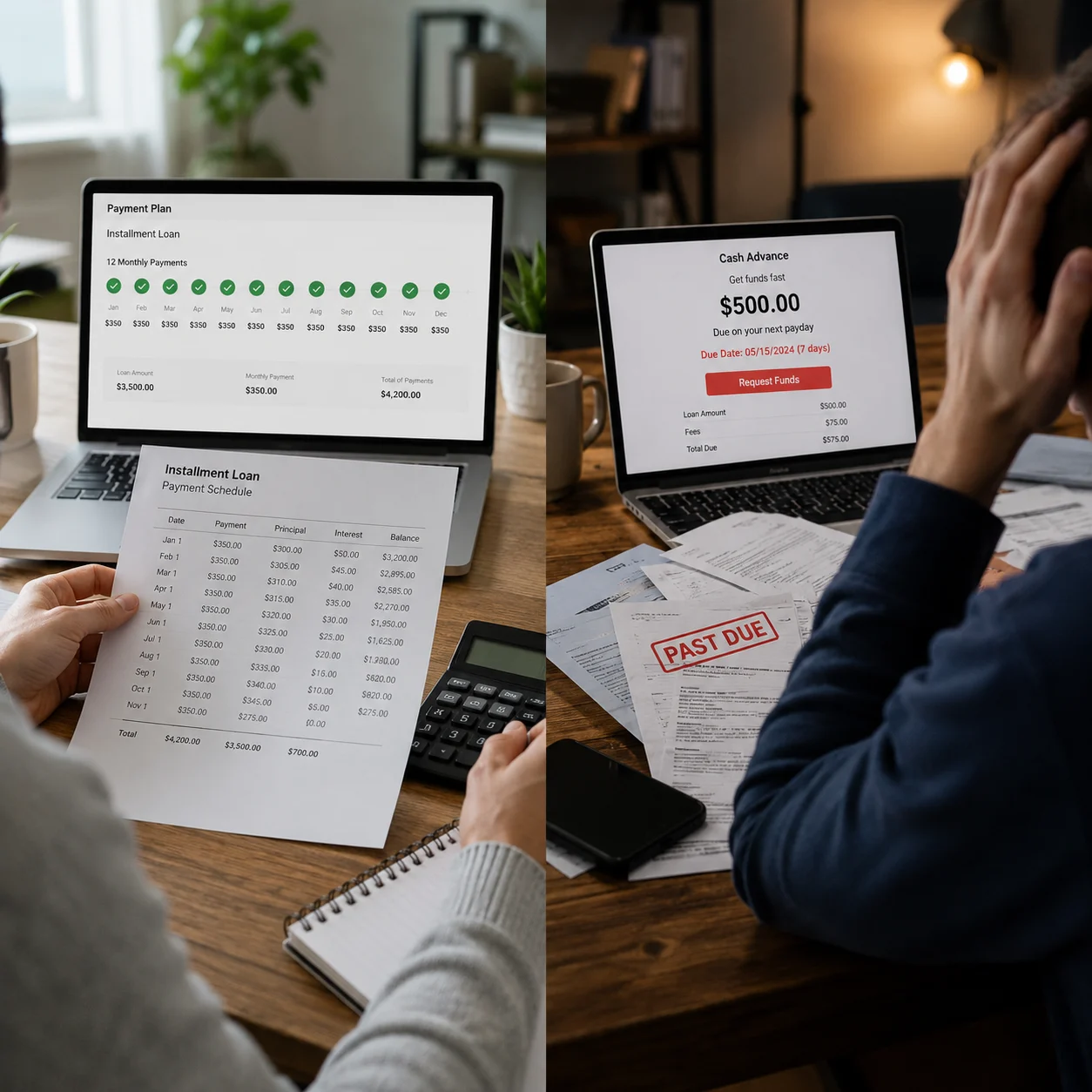
The difference between installment loans vs payday loans is mostly about cost and structure: installment loans are repaid in fixed monthly payments at moderate APRs, while payday loans are tiny, single-payment loans carrying triple-digit APRs. Understanding the gap can save you hundreds or thousands of dollars. This guide compares them clearly and explains when, if ever, a payday loan makes sense.
Quick answer: An installment loan is repaid over months or years in equal payments, with APRs typically in the 8%–36% range. A payday loan is a small, short-term loan due on your next payday, with an average APR near 391% according to the CFPB. For almost every borrower, an installment loan is far cheaper.
Head-to-head comparison
| Feature | Installment loan | Payday loan |
|---|---|---|
| Typical APR | 8%–36% | ~391% average (CFPB) |
| Repayment | Fixed monthly payments | One lump sum on payday |
| Term | Months to years | ~2 to 4 weeks |
| Loan size | $1,000–$100,000 | Usually $500 or less |
| Credit check | Usually yes | Often no |
| Main risk | Overborrowing | Rollover debt cycle |
Why payday loans cost so much
Payday lenders charge a flat fee, commonly $15 per $100 borrowed, for a two-week loan. Annualized, that single fee equals roughly 400% APR. Because the full balance is due in one payment, many borrowers cannot repay on time and “roll over” the loan, paying the fee again and again. The CFPB notes this rollover cycle is the central danger of payday lending.
When each makes sense
An installment loan suits planned expenses, debt consolidation, or any amount you will repay over time. A payday loan should be a true last resort, and even then, safer options usually exist: a Payday Alternative Loan (PAL) from a federal credit union caps APR at 28%, a paycheck advance app, or a small personal installment loan. Before choosing a payday loan, exhaust these alternatives.
Frequently asked questions
For nearly everyone, yes. Installment loans carry far lower APRs (typically 8%–36% versus a payday average near 391%) and predictable monthly payments, which avoids the rollover trap that makes payday loans so expensive.
Often yes, though at a higher APR closer to the 36% cap. Many online and credit-union lenders work with fair or poor credit, and the cost is still dramatically lower than a payday loan.
A Payday Alternative Loan from a federal credit union (interest capped at 28%), a small personal installment loan, a paycheck advance app, or negotiating a payment plan with the original creditor are all cheaper, safer options.
This is educational content, not financial advice. Payday loans carry serious financial risk; explore alternatives first.